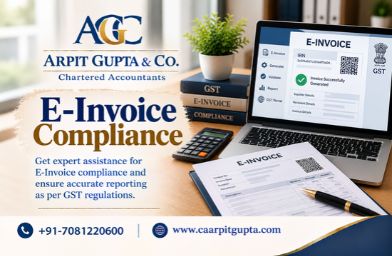
What is E-Invoicing under GST?
E-invoicing is a system in which the details of a B2B tax invoice are sent to a government portal, called the Invoice Registration Portal (IRP), in an electronic form. The portal checks the invoice and gives it a unique number, called the Invoice Reference Number (IRN), and a QR code. The invoice is then treated as a valid e-invoice.
It is important to know that e-invoicing does not mean that the government makes your invoice. You still make the invoice in your own accounting or billing software. The system only registers and validates it.
CA Arpit Gupta helps businesses to find out if e-invoicing applies to them, set up the process, correct errors and keep their returns and e-way bills in line.
Who Is Exempt from E-Invoicing?
The following are generally exempt from e-invoicing:
| Exempt Category |
|
Insurance companies, banking companies and financial institutions, including NBFCs
|
|
Goods transport agencies (GTA)
|
|
Suppliers of passenger transport services
|
|
Suppliers of services by admission to a cinema in a multiplex
|
|
Special Economic Zone (SEZ) units, but not SEZ developers in some cases
|
|
Government departments and local authorities
|
|
A person who is a composition taxpayer or an input service distributor
|
Exemptions can change by notification. Many businesses below the limit also choose to use e-invoicing, since it helps with auto-filling of returns and e-way bills.
Which Documents Need an E-Invoice?
- Tax invoice to a registered business (B2B)
- Invoice for export of goods or services
- Supply to an SEZ unit or developer
- Deemed export supply
- Supply to the government, in covered cases
- Credit notes and debit notes linked with these supplies
- Invoice to a consumer (B2C)
- Bill of supply, delivery challan and receipt voucher
For businesses with very high turnover, a dynamic QR code is needed on the B2C invoices, as per a separate rule. Please check with us if you fall in that group.
How Does the E-Invoice Process Work?
- Step 1: You make the invoice in your ERP, accounting or billing software
- Step 2: The software sends the invoice data, in a fixed JSON format, to the IRP
- Step 3: The IRP checks the data, such as the GSTIN of the buyer, the duplicate invoice number and the HSN code
- Step 4: The IRP generates a unique IRN, which is a 64-character code
- Step 5: The IRP digitally signs the invoice and creates a QR code
- Step 6: The signed invoice comes back to your software
- Step 7: You print the invoice with the QR code and the IRN, or share it in the digital form
- Step 8: The data goes to the GST portal, and fills your GSTR-1 and the buyer's records
- Step 9: If goods are moved, the data can be used to generate the e-way bill
What Details Are Needed in an E-Invoice?
A valid e-invoice must have these details:
- Seller's name, address and GSTIN
- Buyer's name, address and GSTIN
- Invoice number (up to 16 characters) and date
- Description of the goods or services, with HSN or SAC
- Quantity, unit and rate
- Taxable value, rate of tax and amount of CGST, SGST or IGST
- Total invoice value
- Place of supply
- Details of the transporter, if the e-way bill is also generated
- IRN and QR code, added by the IRP
What Are the Benefits of E-Invoice Compliance?
- GSTR-1 and e-way bill details come from the invoice
- Fewer mistakes in the returns, since data is checked at the time of the invoice
- Faster credit for your buyers
- Less chance of fake invoices, which protects honest businesses
- Faster refunds, since the data is already with the department
- Better records and easy checking with the books
- Smoother dealings with large buyers who need e-invoices
What Should You Do to Become E-Invoice Ready?
- Check your aggregate turnover
- Decide whether the software you use can make e-invoices
- Register on the e-invoice portal, and complete the API or the offline tool setup
- Clean your master data
- Test the process in the sandbox or with a few real invoices
- Train your accounts and billing staff on the new steps
- Update your invoice format to include the QR code and the IRN
- Set a daily check of invoices that have been reported or have failed
- Reconcile e-invoice data with GSTR-1 and books every month
- Keep a plan for cancellation, credit notes and error handling
We help with each of these steps.
What Documents and Data Are Needed for E-Invoice Compliance?
- GSTIN and the portal login for the e-invoice system
- List of all GSTINs and states of the same PAN
- Aggregate turnover details for 2017-18 onwards
- Master data of buyers, items, HSN or SAC codes and units
- Invoice series and format used by your business
- Details of your accounting or billing software, and the API details if used
- Details of the transporter, if the e-way bill is also to be generated
- Sample invoices and past mistakes, for testing
Why Choose CA Arpit Gupta for E-Invoice Compliance?
- Chartered Accountant who knows GST law
- Clear applicability check
- Software support
- Reconciliation of IRN data
- E-way bill alignment
- Error handling
- Staff training
- Full GST support
- Easy contact
Get Your E-Invoice Process Right
A wrong invoice can mean loss of credit for your buyers and a penalty for you. Share your business details with CA Arpit Gupta, and we will help you set up and run your e-invoice compliance smoothly.
Call or WhatsApp CA Arpit Gupta at: +91-7081220600.